Conservation science is having a reckoning with parachute science. In the parachute science models, scientists drop into a foreign country with preconceived notions, seeking to validate their assumptions without genuine
engagement with local people, ideas, epistemologies, methodologies,
This paper blends conservation science with legal and policy analysis to assess the primary threats to global shark populations and explores innovative approaches to conservation building upon the philosophy of Earth law, including the Rights pf Nature legal framework.Call Number:
Mangrove ecosystems are under pressure due to anthropogenic stressors and sea level rise. The resilience of mangroves will depend on the rate of accretion of sediments compared to the rate of sea level rise and their capability to colonise higher elevation areas or buffer zones.
This report outlines key human-mangrove relationships in Moata'a, an urban village settlement in Apia, Samoa with the aim to provide an understanding of the relationship between the Moata'a community and their mangrove environment that will inform future development, conservation and climate adap
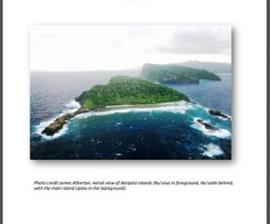
The Aleipata group of offshore islands have been identified as one of eight Key Biodiversity Areas (KBAs) in Samoa. They are located at the south-eastern end of Upolu Island at 14o3’447.28”S, 171o25’23.84”W (Nu’utele) and 14o4’22.11”S and 171o24’36.17”W (Nu’ulua) offshore.
We show that the high seas are colonized by a diverse array of coastal species, which survive and reproduce in the open ocean, contributing strongly to its foating community composition.
Community-based conservation can support livelihoods and biodiversity while reinforcing local and indigenous values, cultures and institutions. Call Number: [EL]Physical Description: 15 p.
Information on the location of known seabird breeding colonies throughout the Pacific including all PICTS, also Hawaii, Australian offshore islands and NZ Kermadecs As of 2025 this database is now available online at http