  • SPREP Home
  • Protected Areas
SPREP Home
Log in
Search
Home | PIPAP - Supporting the sustainable management of protected areas in the Pacific Region.
  • Data
    • Protected Areas
    • Management Effectiveness Dashboard
    • Spatial Data
  • Assistance
    • How SPREP Helps
    • WDPA Protected Area Registration
    • Protected Area Working Group
  • Resource Hub
    • Publications
    • Decision Making Support Tools
    • Case Studies
  • Newsletter
    • Browse Newsletter Archive
    • Subscribe Now
  • Account
    • Login

Main menu

  • Data
  • Assistance
  • Resource Hub
  • Newsletter
  • Account

Breadcrumb

  1. Home
  2. Resource Hub
  3. Publications

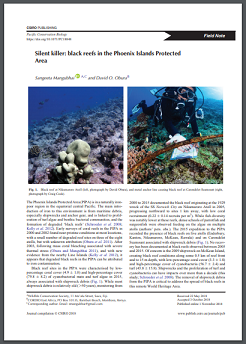
Field Note - Silent killer: black reefs in the Phoenix Islands Protected Area

The Phoenix Islands Protected Area (PIPA) is in a naturally ironpoor region in the equatorial central Pacific. The main introduction of iron to this environment is from maritime debris, especially shipwrecks and anchor gear, and is linked to proliferation of turf algae and benthic bacterial communities, and the formation of degraded ‘black reefs’...

Full Pdf

Links
Full Pdf
Publication
Related page category(s)
Coral Reef
Data Analysis And Interpretation
Marine Resources
Pacific Protected Areas
Related Pages
Including Local EcologicalKnowledge (LEK) inMangrove Conservation& Restoration
Unlocking the potential of other effective area-based conservation measures (OECMs) for achieving conservation targets: A global scoping review
Why Biodiversity Protection Relies on People-Nature Bonds
Businesses and Biodiversity: New opportunities with Other Effective Area-Based Conservation Measures (OECMs)
Devastation of island biodiversity: a land snail perspective
The new World Ocean Review: Explaining life in the ocean
GBIF Metabarcoding Data Toolkit (MDT)
Collaborative Science Is Key to Conserving Highly Mobile Marine Species
Bending back the curve of shark and ray biodiversity loss
How to ensure social outcomes in restoration

Latest News

DSM
Te Ipukarea Society: The deep-sea double standard
February 12, 2026 by Isaac Rounds
Read More
Tahiti
60,000 drifting fish aggregating devices (FADs) per year: French Polynesia…
February 11, 2026 by Isaac Rounds
Read More
spc
Environmental Sustainability Adviser
February 11, 2026 by Isaac Rounds
Read More
SPC
Collection Manager (Pacific Marine Specimen Bank)
February 11, 2026 by Isaac Rounds
Read More

Latest Resources

Biodiversity bonds can work, but their design flaws must be fixed (…
February 11, 2026 by Isaac Rounds
Read More
Including Local EcologicalKnowledge (LEK) inMangrove Conservation&…
February 10, 2026 by Isaac Rounds
Read More
Unlocking the potential of other effective area-based conservation…
February 10, 2026 by Isaac Rounds
Read More
Why Biodiversity Protection Relies on People-Nature Bonds
February 4, 2026 by Isaac Rounds
Read More
Biodiversity and Protected Areas Management Programme Logo Organisation of African, Caribbean and Pacific States Logo Sprep BioScapes Logo Flag of European Union International Union for Conservation of Nature Logo European Commission Logo

SPREP Footer Logo

A resilient Pacific environment sustaining our livelihoods and natural heritage in harmony with our cultures.

+685 21929
[email protected]

  • SPREP on Facebook
  • SPREP on YouTube
  • SPREP on Twitter
Protected Areas by Country
  • American Samoa
  • Cook Islands
  • Fiji
  • French Polynesia
  • Guam
  • Kiribati
  • Marshall Islands
  • Micronesia (Federated States of)
  • Nauru
  • New Caledonia
  • Niue
  • Northern Mariana Islands
  • Palau
  • Papua New Guinea
  • Samoa
  • Solomon Islands
  • Timor-Leste
  • Tokelau
  • Tonga
  • Tuvalu
  • Vanuatu
  • Wallis and Futuna
SPREP © 2026. All rights reserved.