  • SPREP Home
  • Protected Areas
SPREP Home
Log in
Search
Home | PIPAP - Supporting the sustainable management of protected areas in the Pacific Region.
  • Data
    • Protected Areas
    • Management Effectiveness Dashboard
    • Spatial Data
  • Assistance
    • How SPREP Helps
    • WDPA Protected Area Registration
    • Protected Area Working Group
  • Resource Hub
    • Publications
    • Decision Making Support Tools
    • Case Studies
  • Newsletter
    • Browse Newsletter Archive
    • Subscribe Now
  • Account
    • Login

Main menu

  • Data
  • Assistance
  • Resource Hub
  • Newsletter
  • Account

Breadcrumb

  1. Home
  2. Resource Hub
  3. Publications

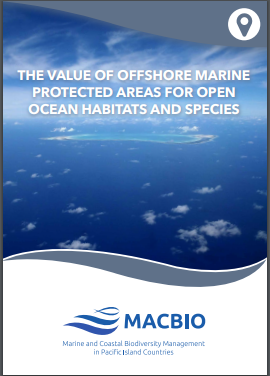
The value of offshore marine protected areas for open ocean habitats and species

This paper reviews the value of, especially, no-take marine protected areas (MPAs), specifically for protecting offshore areas. It describes open ocean habitats and explores the question of whether offshore MPAs can be effective in helping to ensure the future of the open ocean’s pelagic and benthic habitats and species including large, wide-ranging and migratory fauna that inhabit all depths of the ocean. 

Full paper (Pdf)

Links
Full Pdf
Publication
Related page category(s)
Conservation Processes
Protected Area Network Design
Marine Planning
Marine Resources
Pacific Protected Areas
Related Pages
Aligning climate-smart marine spatial planning and ecoscape restoration for global biodiversity recovery
PICRC publishes study on longnose emperor spawning aggregation
Including Local EcologicalKnowledge (LEK) inMangrove Conservation& Restoration
Unlocking the potential of other effective area-based conservation measures (OECMs) for achieving conservation targets: A global scoping review
Why Biodiversity Protection Relies on People-Nature Bonds
Businesses and Biodiversity: New opportunities with Other Effective Area-Based Conservation Measures (OECMs)
Devastation of island biodiversity: a land snail perspective
The new World Ocean Review: Explaining life in the ocean
Collaborative Science Is Key to Conserving Highly Mobile Marine Species
Bending back the curve of shark and ray biodiversity loss

Latest News

UN
2026 UNITED NATIONS-NIPPON FOUNDATION OCEAN GOVERNANCE FELLOWSHIP FOR SIDS
February 13, 2026 by Isaac Rounds
Read More
UN-Nippon
2026 UNITED NATIONS-NIPPON FOUNDATION STRATEGIC NEEDS FELLOWSHIP
February 13, 2026 by Isaac Rounds
Read More
Reverse the Red
Port Moresby Nature Park celebrates efforts to protect endangered species
February 13, 2026 by Isaac Rounds
Read More
Zoo
Hertfordshire Zoo Grant
February 12, 2026 by Isaac Rounds
Read More

Latest Resources

Aligning climate-smart marine spatial planning and ecoscape restoration…
February 13, 2026 by Isaac Rounds
Read More
PICRC publishes study on longnose emperor spawning aggregation
February 12, 2026 by Isaac Rounds
Read More
Biodiversity bonds can work, but their design flaws must be fixed (…
February 11, 2026 by Isaac Rounds
Read More
Including Local EcologicalKnowledge (LEK) inMangrove Conservation&…
February 10, 2026 by Isaac Rounds
Read More
Biodiversity and Protected Areas Management Programme Logo Organisation of African, Caribbean and Pacific States Logo Sprep BioScapes Logo Flag of European Union International Union for Conservation of Nature Logo European Commission Logo

SPREP Footer Logo

A resilient Pacific environment sustaining our livelihoods and natural heritage in harmony with our cultures.

+685 21929
[email protected]

  • SPREP on Facebook
  • SPREP on YouTube
  • SPREP on Twitter
Protected Areas by Country
  • American Samoa
  • Cook Islands
  • Fiji
  • French Polynesia
  • Guam
  • Kiribati
  • Marshall Islands
  • Micronesia (Federated States of)
  • Nauru
  • New Caledonia
  • Niue
  • Northern Mariana Islands
  • Palau
  • Papua New Guinea
  • Samoa
  • Solomon Islands
  • Timor-Leste
  • Tokelau
  • Tonga
  • Tuvalu
  • Vanuatu
  • Wallis and Futuna
SPREP © 2026. All rights reserved.