The commitment to protect 30% of the Earth’s terrestrial, inland water, coastal and marine areas by 2030 under the Kunming-Montreal Global Biodiversity Framework has seen growing attention paid to ‘other effective area-based conservation measures’ (OECMs) to help achieve this target.
Transoceanic dispersal to far-away islands is an important mechanism for the generation of new species lineages and biotas and has captivated scientists since at least the time of Darwin.
Based on original ethnographic and ethnobotanical research, we share how in the cosmology of Tanna, an island in Vanuatu’s southernmost province of Tafea, the Sun is viewed as a living, interactive being.
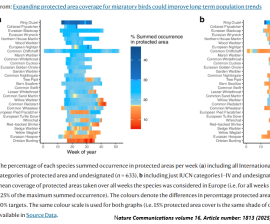
Populations of many migratory taxa have been declining over recent decades. Although protected areas are a cornerstone for conservation, their role in protecting migratory species can be incomplete due to the dynamic distributions of these species.
The Pacific BioScapes Programme is strengthening regional and national decision-making processes for sustainable management and use of coastal and marine biodiversity by improving the use of information and communication technologies for data management and analysis.
The Pacific BioScapes Programme is supporting local community monitoring of coastal ecosystem resilience on the islands of Maninita, Taula, Fangasito, Fonua’one’one, Mu’omu’a and Fua’amotu in the Vava’u group.
ABC, Project Wild visits Tonga to witness the efforts by three ladies, from the Vava'u Environmental Protection Association (VEPA) to save the Tongan Whistler (an endemic bird to Tonga), by eradicating rats with bait stations and removing other food sources such as the Invasive weed - Lopa.
The International Organization for Migration (IOM) was engaged by the Government of the Republic of the Marshall Islands (RMI) to lead community engagements on the National Adaptation Plan (NAP) in eight Atolls.