  • SPREP Home
  • Protected Areas
SPREP Home
Log in
Search
Home | PIPAP - Supporting the sustainable management of protected areas in the Pacific Region.
  • Data
    • Protected Areas
    • Management Effectiveness Dashboard
    • Spatial Data
  • Assistance
    • How SPREP Helps
    • WDPA Protected Area Registration
    • Protected Area Working Group
  • Resource Hub
    • Publications
    • Decision Making Support Tools
    • Case Studies
  • Newsletter
    • Browse Newsletter Archive
    • Subscribe Now
  • Account
    • Login

Main menu

  • Data
  • Assistance
  • Resource Hub
  • Newsletter
  • Account

Breadcrumb

  1. Home
  2. Resource Hub
  3. Publications

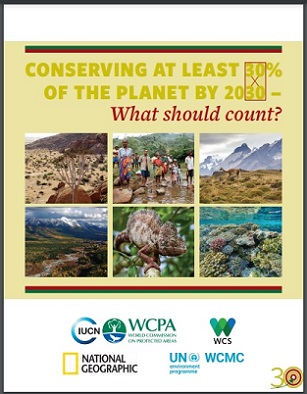
CONSERVING AT LEAST 30% OF THE PLANET BY 2030 – What should count?

This brief seeks to bring clarity to the question of what could count toward the 30% global minimum target. within the context of recognized area-based conservation measures and their ability to deliver positive long-term conservation outcomes. It is based on guidance from the International Union for Conservation of Nature (IUCN) and other published sources, and is consistent with decisions of the Conference of the Parties to the Convention on Biological Diversity (CBD).

Full Paper (Pdf)

Publication
Related page category(s)
Conservation Processes
Protected Area Network Design
Marine Planning
Progress Towards Protected Area Targets
Global
Related Pages
Businesses and Biodiversity: New opportunities with Other Effective Area-Based Conservation Measures (OECMs)
Devastation of island biodiversity: a land snail perspective
The new World Ocean Review: Explaining life in the ocean
GBIF Metabarcoding Data Toolkit (MDT)
Collaborative Science Is Key to Conserving Highly Mobile Marine Species
Bending back the curve of shark and ray biodiversity loss
Litter accumulation in tropical mangroves threatens biodiversity and local communities
How to ensure social outcomes in restoration
Socio-environmental movements emerge as key global guardians of biodiversity amid rising violence

Latest News

Deep sea mining
Trump administration eyes US Pacific territories as it moves towards deep-…
February 3, 2026 by Isaac Rounds
Read More
Cook Islands
Cook Islands prepares domestic groundwork as global ocean treaty takes…
February 3, 2026 by Isaac Rounds
Read More
Economics of biodiversity loss
The economics of biodiversity loss: Implications for Asia and the Pacific
February 3, 2026 by Isaac Rounds
Read More
CORDAP
CORDAP Funding Award Coral Local Innovation Program (CLIP)
February 3, 2026 by Isaac Rounds
Read More

Latest Resources

Businesses and Biodiversity: New opportunities with Other Effective Area-…
February 3, 2026 by Isaac Rounds
Read More
Businesses and Biodiversity: New opportunities with Other Effective Area-…
February 3, 2026 by Isaac Rounds
Read More
Devastation of island biodiversity: a land snail perspective
February 2, 2026 by Isaac Rounds
Read More
The new World Ocean Review: Explaining life in the ocean
January 30, 2026 by Isaac Rounds
Read More
Biodiversity and Protected Areas Management Programme Logo Organisation of African, Caribbean and Pacific States Logo Sprep BioScapes Logo Flag of European Union International Union for Conservation of Nature Logo European Commission Logo

SPREP Footer Logo

A resilient Pacific environment sustaining our livelihoods and natural heritage in harmony with our cultures.

+685 21929
[email protected]

  • SPREP on Facebook
  • SPREP on YouTube
  • SPREP on Twitter
Protected Areas by Country
  • American Samoa
  • Cook Islands
  • Fiji
  • French Polynesia
  • Guam
  • Kiribati
  • Marshall Islands
  • Micronesia (Federated States of)
  • Nauru
  • New Caledonia
  • Niue
  • Northern Mariana Islands
  • Palau
  • Papua New Guinea
  • Samoa
  • Solomon Islands
  • Timor-Leste
  • Tokelau
  • Tonga
  • Tuvalu
  • Vanuatu
  • Wallis and Futuna
SPREP © 2026. All rights reserved.