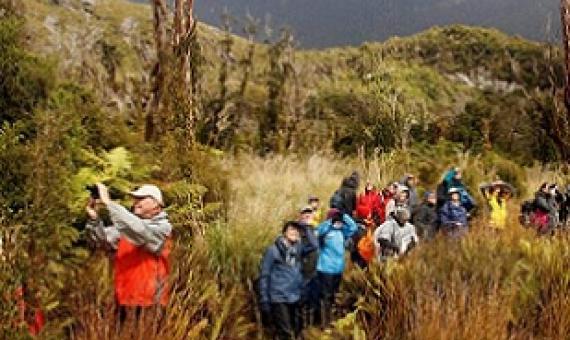
Malaita Premier Daniel Suidani has welcomed and congratulated Mai Masina Green Belt, a local environmental group, over the weekend.
In northern Cambodia, giant ibis, white-winged ducks and other rare species have helped ecotourism take flight in recent years.
World Database on Protected Areas
The World Database on Protected Areas (WDPA) is the most comprehensive global database of marine and terrestrial protected areas, updated on a monthly basis, and is one of the key global biodiversity data sets being widely used by scientists, businesses, governments, International secretariats and others to inform planning, policy decisions and management. The WDPA is a joint project between UN Environment and the International Union for Conservation of Nature (IUCN).
Vertebrates on the brink as indicators of biological annihilation and the sixth mass extinction
The ongoing sixth mass species extinction is the result of the destruction of component populations leading to eventual extirpation of entire species. Populations and species extinctions have severe implications for society through the degradation of ecosystem services. Here we assess the extinction crisis from a different perspective. We examine 29,400 species of terrestrial vertebrates, and determine which are on the brink of extinction because they have fewer than 1,000 individuals. There are 515 species on the brink (1.7% of the evaluated vertebrates).
Next week the Department of Environmental Protection and Conservation (DEPC) will be celebrating the Vanuatu National Environment Week (VNEW) in Port Vila to coincide with World Environment Day (WED) which falls on June 5th every year.
Satellites can help monitor industry and highlight environmental harm.
Biodiversity policy beyond economic growth
Increasing evidence—synthesized in this paper—shows that economic growth contributes to biodiversity loss via greater resource consumption and higher emissions. Nonetheless, a review of international biodiversity and sustainability policies shows that the majority advocate economic growth. Since improvements in resource use efficiency have so far not allowed for absolute global reductions in resource use and pollution, we question the support for economic growth in these policies, where inadequate attention is paid to the question of how growth can be decoupled from biodiversity loss.
Sixteen farming, conservation and Indigenous groups are together lobbying the Queensland government for extra money to protect Queensland's network of privately owned nature refuges. Many of these refuges offer protection to species facing extinction.
Humanity’s ongoing destruction of nature threatens the survival of our species, a group of former foreign ministers has warned, calling on leaders to step back from “the precipice” of irreversible ecological ruin and protect the planet.
Prominent Cook Islands environmentalist, Jacqui Evans, has set up the Moana Foundation to help support non-governmental organisations (NGOs) in the country. Ms Evans last year won the prestigious Goldman Environmental Prize for her work in establishing the country's huge marine res