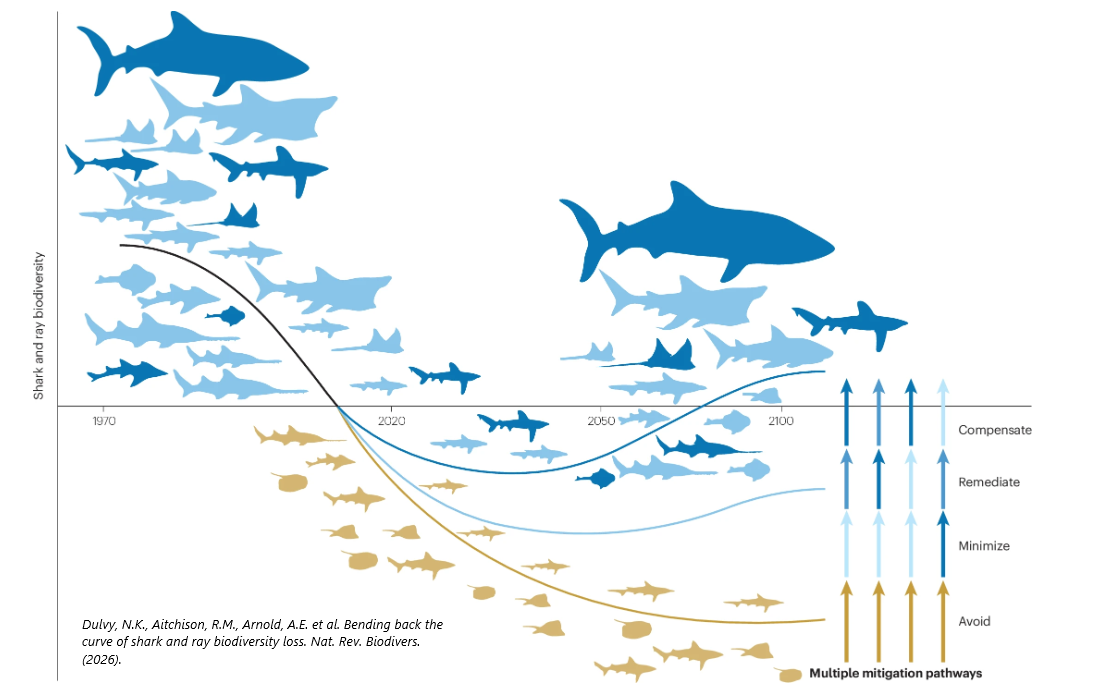
Sharks and rays are sentinels of the state of the ocean. Since the mid-twentieth century, overall abundance has declined by nearly 65% and over one-third (37.5%) of species are threatened, causing widespread changes in community structure. This crisis stems from unregulated fisheries expansion coupled with inadequate catch-and-trade monitoring that fail to account for the complexity of shark and ray products, their use and global trade flows. In this Review, we assess the state of shark and ray populations worldwide, remedies to reverse their decline, and challenges and barriers to conservation. Stark geographic and taxonomic biases persist in essential data, requiring integrated species distribution modelling, data mobilization, trait prediction and new threat maps of fishing mortality. Addressing management gaps requires regulatory and market-based approaches that must ultimately reduce fishing mortality, link international frameworks to national fisheries management tools, and implement a mitigation hierarchy of management actions through sound compliance management across supply, trade and demand chains. Case studies reveal strengths and weaknesses in management effectiveness and demonstrate successful recoveries for wide-ranging and restricted-range species. Finally, we identify 6 key challenges and propose 25 research questions and actionable recommendations to bend back the curve of shark and ray biodiversity loss.