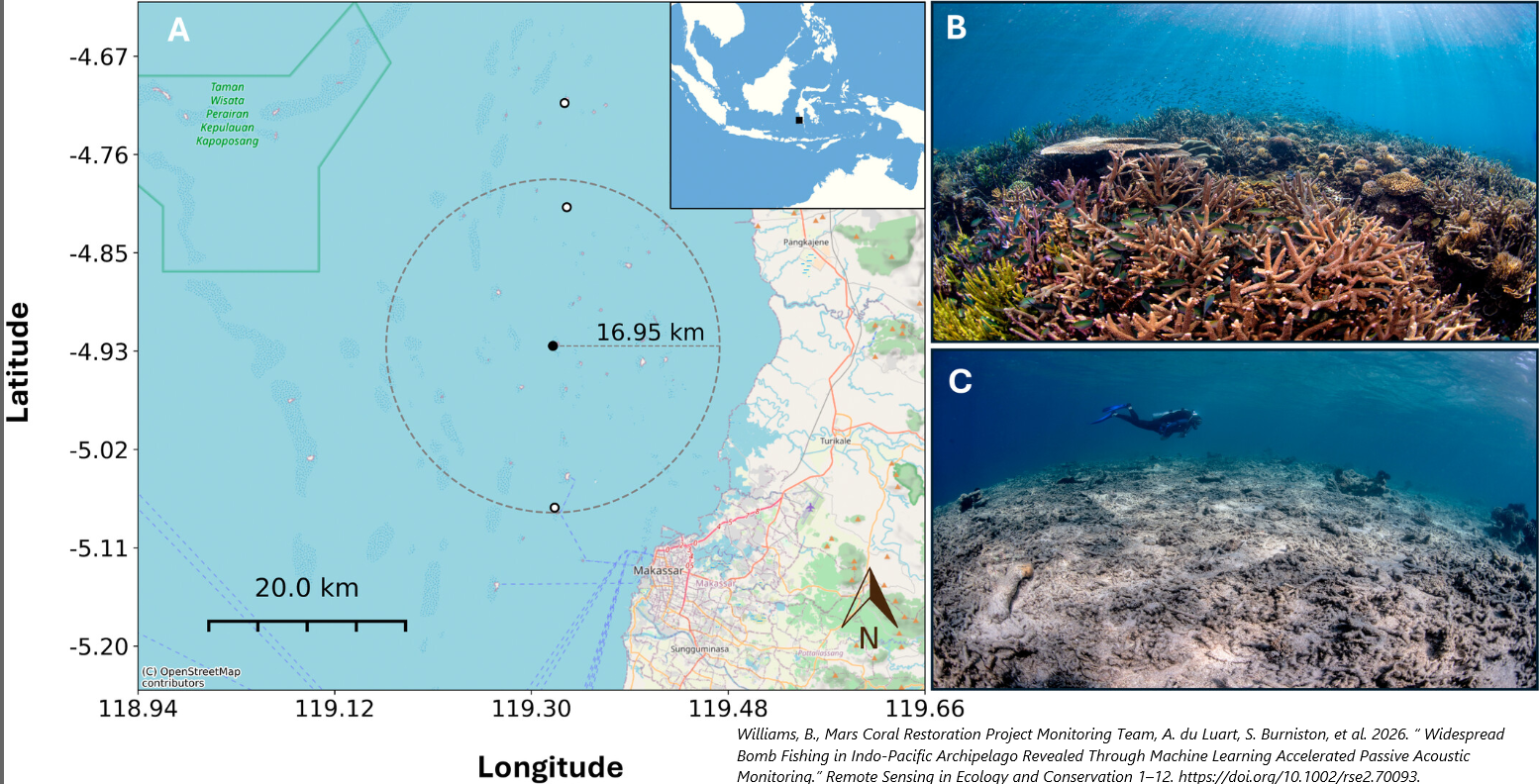
Bomb fishing is recognised as the most destructive fishing practice that can be performed in our oceans. This practice involves the use of improvised explosives to stun or kill fish for harvest. Bomb fishing is primarily undertaken on highly threatened tropical coral reef habitats where it accelerates ecological degradation that destabilises communities dependent on these habitats. However, the true extent of bomb fishing in impacted regions is unknown, making it difficult to identify hotspots and activity patterns required to inform management. Here, we present the first quantitative estimate of bomb fishing intensity and temporal patterns in the Spermonde Archipelago, South Sulawesi, Indonesia—a global marine biodiversity hotspot. We developed a machine learning-based acoustic monitoring system (BombDetect), with an estimated detection distance of at least 16.95 km, and deployed this over a 16-month period to measure bomb fishing incidents. From the 3650.88 h of audio gathered, we detected and verified 3.567 blasts, equivalent to 23.14 per day, equating to 8446.1 blasts and up to 16.72 ha of reef degradation per year. Bomb fishing occurred year-round, mostly during daylight hours, with significant reductions on Fridays (local prayer day) and during a period of stormy weather. These findings quantify patterns of occurrence of a dominant driver of long-term reef decline in the region. We demonstrate the efficacy of a low-cost approach for quantifying this underreported destructive fishing pressure at scale, which can be readily adapted to other impacted regions to support urgent conservation action.