Protected Area targets have been set globally, regionally, and sometimes at a country level. During the last decade, the global protected area targets that all country signatories to the Convention on Biological Diversity (CBD) committed to were the CBD's Aichi Biodiversity Targets. Specifically, Aichi Target 11 which stated that:
at least 17 per cent of terrestrial and inland water, and 10 per cent of coastal and marine areas, especially areas of particular importance for biodiversity and ecosystem services, are conserved through effectively and equitably managed, ecologically representative and well connected systems of protected areas and other effective area-based conservation measures, and integrated into the wider landscapes and seascapes by 2020.
The new Kunming-Montreal Global Biodiversity Framework (GBF) was adopted in December 2022 at the 15th Meeting of the Conference of the Parties to the Convention on Biological Diversity (CBD COP15). CBD country signatories have committed to implementing the protected area target (Target 3) of the new GBF by the year 2030. The text of Target 3 is below:
Ensure and enable that by 2030 at least 30 per cent of terrestrial, inland water, and of coastal and marine areas, especially areas of particular importance for biodiversity and ecosystem functions and services, are effectively conserved and managed through ecologically representative, well-connected and equitably governed systems of protected areas and other effective area-based conservation measures, recognizing indigenous and traditional territories, where applicable, and integrated into wider landscapes, seascapes and the ocean, while ensuring that any sustainable use, where appropriate in such areas, is fully consistent with conservation outcomes, recognizing and respecting the rights of indigenous peoples and local communities including over their traditional territories.
Regionally, the Micronesia Challenge aims to effectively conserve at least 30% of near-shore marine resources and 20% of terrestrial resources across Micronesia by 2020. An example of a country-based target is Fiji that aims to have 30% of reefs protected by 2015 and 30% of waters managed as a marine protected area network by 2020. During the 24th Micronesia Island Forum in 2019, the Leaders recognized the success in the first 15 years of the Micronesia Challenge and endorsed the new Micronesia Challenge 2030 goals to effectively manage 50% of marine resources, including the exclusive economic zone (EEZ), and 30% of terrestrial resources by 2030.
Below are various efforts that have been carried out to assess global and regional progress towards the Aichi protected area targets. The paper by Govan (2009) is the most comprehensive assessment of marine protected areas (MPAs), including all LMMAs in the Pacific Islands. Govan’s data has now been incorporated into the World Database on Protected Areas (WDPA). Several of the papers below attempt to assess progress towards targets which relate to factors such as management effectiveness, biodiversity coverage, governance and finance etc.
As we move closer to 2030, further technical guidance on implementing the new GBF Target 3 that becomes available will be added to the resources section below. Furthermore, the resources section will be updated as needed to include any new papers or guidance related to taking stock of national, regional and global progress in implementing the GBF Target 3.
Potential of different area-based governance mechanisms for achieving Global Biodiversity Framework goals

The Kunming–Montreal Global Biodiversity Framework (GBF) includes a target to protect 30% of land by 2030, identifying other effective area-based conservation measures (OECMs) as complementary to Protected Areas (PAs). However, their contribution to conservation outcomes remains uncertain.
Practice Standards for Debt Conversion Projects for Nature, Resilience, and People
Today the world faces three interconnected crises: biodiversity loss, climate change, and unsustainable debt, each greatly exacerbating the other.
Predicting the optimal amount of time to spend learning before designating protected habitat for threatened species
Deciding when to protect threatened species habitat when complete knowledge about the habitat extent is uncertain is a common problem in conservation. More accurate habitat mapping improves conservation outcomes once that habitat is protected.
Preserving paradise: the value of protecting Papua New Guinea's forests for climate
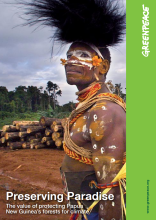
Papua New Guinea (PNG) hosts some of the world's largest and last remaining intact forest landscapes.
Principles for Ecosystem Restoration to Guide the United Nations Decade 2021-2030
Aware of the critical need to halt, prevent and reverse ecosystem degradation, and to effectively restore degraded terrestrial, freshwater and marine ecosystems across the globe, through Resolution 73/284, the United Nations General Assembly declared 2021–2030 as the United Nations Decade on Ecos
Priority Sites for Conservation in Kiribati: Key Biodiversity Areas
This KBA report outlines key recommendations for the Government of Kiribati and its people for protecting its unique biodiversity and supporting sustainable livelihoods. A total of twenty-two island KBAs were identified and suggested for immediate management.
Priority Sites for Conservation in the Cook Islands: Key Biodiversity Areas and Important Bird Areas
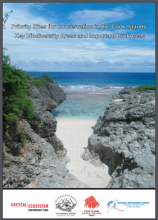
In 2010, with the assistance of Conservation International and the Critical Ecosystems Partnership Fund, Birdlife International in partnership with the Cook Islands environmental NGO Te Ipukarea Society commenced a project to identify and delineate KBAs and IBAs in the Cook Islands.
Progress Towards the CBD Protected Area Management Effectiveness Targets
Coad, L. Leverington, F., Burgess, N., Cuadros, I., Geldmann, J., Marthews, T., Mee, J., Nolte, C., Stoll-Kleemann, S., Vansteelant, N., Zamora, C., Zimsky, M., Hockings, M.
Promoting Synergies Between Climate Change Adaptation and Biodiversity
This technical brief is a joint collaboration with the Nairobi work programme expert group on biodiversity and climate change adaptation and has been published as a supplement to the NAP technical guidelines.
Protect and restore: integrating marine management to secure the future of coastal ecosystems
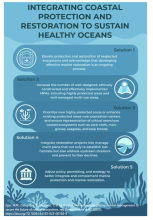
We must integrate effective protection with scalable restoration to ensure resilient coastal ecosystems.
Protected area connectivity: Shortfalls in global targets and country-level priorities
Connectivity of protected areas (PAs) is crucial for meeting their conservation goals.
Protected Area Governance and Management
The world’s more than 200 000 protected areas come in many forms, on land and at sea, and occur in every country (Bertzky et al. 2012). They are places that people establish to conserve natural and cultural heritage and to sustain their benefits for society.
Protected Area Governance and Management
This book has been prepared as a contribution to the IUCN World Parks Congress in Sydney in 2014. The global community is at the interface of ensuring the quality of protected area governance and management, together with the way that effectively managed and
Protected area management has significant spillover effects on vegetation
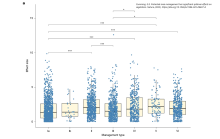
The Kunming–Montreal Global Biodiversity Framework calls for rapid global expansion of protected areas in response to ongoing biodiversity loss and ecosystem degradation1. One of its strongest selling points is the benefits protected areas provide to adjacent human communities2,3.
Protected Area Network Expansion and Management: Economics to improve conservation outcomes
This paper identifies the Dasgupta Review’s key points about the role of protected areas (PAs) in conserving nature.
Protected Area Short Courses in Australia, Asia and the Pacific: training issues, needs and recommendations
This report is the outcome of a review commissioned by the Protected Areas Learning and Research Collaboration (PALRC) in 2018, with the following aims:
Protected area targets post-2020
In 2010, Parties to the Convention on Biological Diversity (CBD) adopted the Strategic Plan for Biodiversity 2011–2020, and its 20 Aichi Biodiversity Targets, to catalyze national and international conservation efforts and reverse negative biodiversity trends.
Protected Areas and the Global Conservation of Migratory Birds
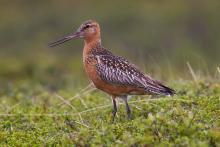
Runge, C. A., J. E. M. Watson, S. H. M. Butchart, J. O. Hanson, H. P. Possingham, and R. A. Fuller. 2015 .
Protected areas are now the last strongholds for many imperiled mammal species
The global network of terrestrial protected areas (PAs) has experienced a fourfold expansion since the 1970s.
Protected areas expanding fast but failing to halt nature loss, studies warn
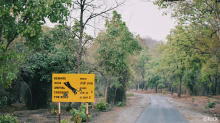
New research suggests that the rapid expansion of protected areas worldwide is giving a misleading picture of progress, with biodiversity continuing to decline inside many sites designated for protection.
Protected areas in the world’s ecoregions: How well connected are they?
Protected areas (PAs) are the main instrument for biodiversity conservation, which has triggered the development of numerous indicators and assessments on their coverage, performance and efficiency.
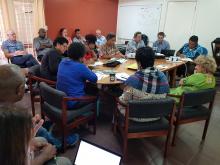
Protected Areas Learning and Research Collaboration (PALRC)

Protected Areas Learning and Research Collaboration (PALRC)
The purposes of PALRC are to:
Protected Planet Report 2012 Tracking Progress Towards Global Targets for Protected Areas
Bastian Bertzky, B., Corrigan, C., Kemsey, J., Kenney, S., Ravilious, C., Besançon, C. and Burgess, N.
Protected Planet Report 2020

We are entering an era of unparalleled opportunity to address the global crisis facing nature.
Protected-area targets could be undermined by climate change-driven shifts in ecoregions and biomes
Expanding the global protected area network is critical for addressing biodiversity declines and the climate crisis. However, how climate change will affect ecosystem representation within the protected area network remains unclear.
Protecting 30% of the planet for nature: costs, benefits and economic implications
The current report, based on the work of over 100 economists/scientists, analyses the global economic implications of a 30% PA target for agriculture, forestry, fisheries, and the PA/nature sector itself.
Protecting 30% of the planet for nature: costs, benefits and economic implications
The current report, based on the work of over 100 economists/scientists, analyses the global economic implications of a 30% PA target for agriculture, forestry, fisheries, and the PA/nature sector itself.
Protecting the right 30% by 2030: Are We Ready to Deliver?
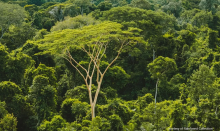
Last month, the world marked the International Day of Biological Diversity at an extraordinary moment when political will, global targets, funding, and capacity are aligned to scale up protected and conserved areas globally.
Quality of marine protected areas is critical to achieving global biodiversity targets
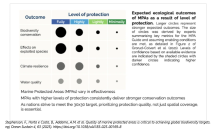
Summarising CBD target 3 to “30 × 30” emphasizes area coverage, but conservation success depends on MPA quality. Many existing MPAs are under-protected, and rapidly designating new areas risks creating ‘paper parks’ without ecological or social benefits.
Quantifying longline bycatch mortality for pelagic sharks in western Pacific shark sanctuaries
Marine protected areas are increasingly touted for their role in conserving large marine predators such as sharks, but their efficacy is debated.

Rapid Biodiversity Assessment (BIORAP) Nauru (June 2013) - Synthesis Report : Key findings and recommendations
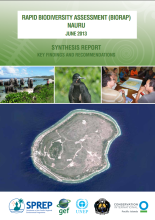
A BIORAP is a biological inventory programme undertaken in marine and terrestrial environments, and is designed to rapidly assess the biodiversity of highly diverse areas.
Rapid Biodiversity Assessment (BIORAP) of Republic of Nauru
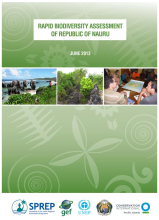
The purpose of the Nauru BIORAP was to improve the state of knowledge of marine and terrestrial ecosystems, to provide a scientific basis for the conservation and management of nationally, regionally and globally important ecosystems and species.
Rapid Biodiversity Assessment (BIORAP) of the Vava'u Archipelago, Kingdom of Tonga (February 2014) - Full Report
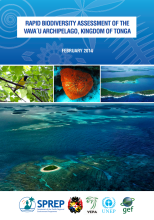
The Biological Rapid Assessment Programme (BIORAP) is a biological survey based on a concept developed by Conservation International and designed to use scientific information to catalyse conservation action.
Rapid Biodiversity Assessment (BIORAP) Vava'u Group - Kingdom of Tonga (February 2014) - Synthesis Report : Key findings and recommendations
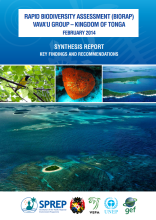
A BIORAP is a biological inventory programme undertaken in marine and terrestrial environments, and is designed to rapidly assess the biodiversity of highly diverse areas.
Rapid Biodiversity Assessment (BIORAP), Nauru. June 2013 - Synthesis Report
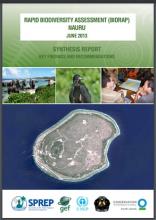
A BIORAP is a biological inventory programme undertaken in marine and terrestrial environments, and is designed to rapidly assess the biodiversity of highly diverse areas.
Rapid biodiversity assessment of key biodiversity areas: Falealupo peninsula coastal rainforest, central Savaii rainforest, and Uafato-Tiavea costal rainforest, Samoa
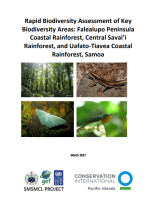
A Biological Rapid Assessment Program (BIORAP) was conducted from July 16 to August 3, 2016 in three Key Biodiversity Areas (KBAs) in Samoa: the Central Savai’i Rainforest KBA, and the Falealupo Peninsula Coastal Rainforest KBA on Savaii; and the Uafato-Tiavea Coastal Rainforest KBA on Upolu.
Rapid Biodiversity Assessment of Upland Savai'i, Samoa (BIORAP)
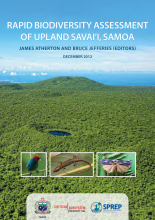
his BIORAP (Biological Rapid Assessment Program) survey was undertaken as part of the process to facilitate improved management of the forests and biodiversity of Upland Savaii.
Rapid Biodiversity Assessment of Upland Savai'i, Samoa (BIORAP)
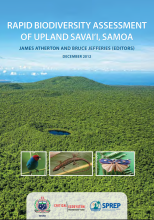
This BIORAP (Biological Rapid Assessment Program) survey was undertaken as part of the process to facilitate improved management of the forests and biodiversity of Upland Savaii.
Rapid Biological Assessments of the Nakanai Mountains and the upper Strickland Basin: surveying the biodiversity of Papua New Guinea’s sublime karst environments
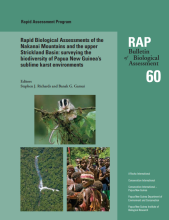
The independent state of Papua New Guinea (PNG) occupies the eastern half of New Guinea, the world’s largest and highest tropical island and one of the last major tropical wilderness areas on earth.
Rarotonga fringing reef survey, 2003 report
This report has been prepared on behalf of the Environment Service, Cook Islands as part of an ongoing monitoring programme of reef health of the fringing reef of Rarotonga.
Realising the Healthy Islands Vision through Cross-Sector, Planning, Data and Action : Policy Brief
Fiji and other Pacific Island Countries face a high risk of communicable disease outbreaks caused by endemic, emerging and re-emerging disease, which are influenced by social, economic and ecological changes. Call Number: [EL]Physical Description: 2 p.
Realising the Healthy Islands Vision through Cross-Sector, Planning, Data and Action : Policy Brief
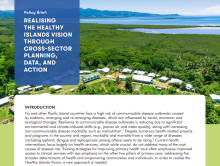
Fiji and other Pacific Island Countries face a high risk of communicable disease outbreaks caused by endemic, emerging and re-emerging disease, which are influenced by social, economic and ecological changes.
Rebuilding marine life
Sustainable Development Goal 14 of the United Nations aims to “conserve and sustainably use the oceans, seas and marine resources for sustainable development”.
Reducing disease risks in protected areas: New toolkit launched to safeguard human, wildlife and ecosystem health
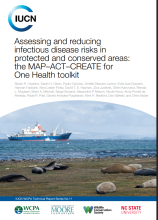
Protected and Conserved Areas (PCAs) safeguard biodiversity and provide essential ecosystem services for human and animal health, from water filtration to climate regulation. Yet PCAs can also be places where infectious diseases can emerge or spread among people, wildlife, and domestic animals.
Reef Life Explorer

Reef Life Explorer is an interactive platform exploring the health of thousands of reefs worldwide. As part of the Reef Life Survey Program, hundreds of citizen science divers take to the ocean to measure and record the state of global reef ecosystems.